

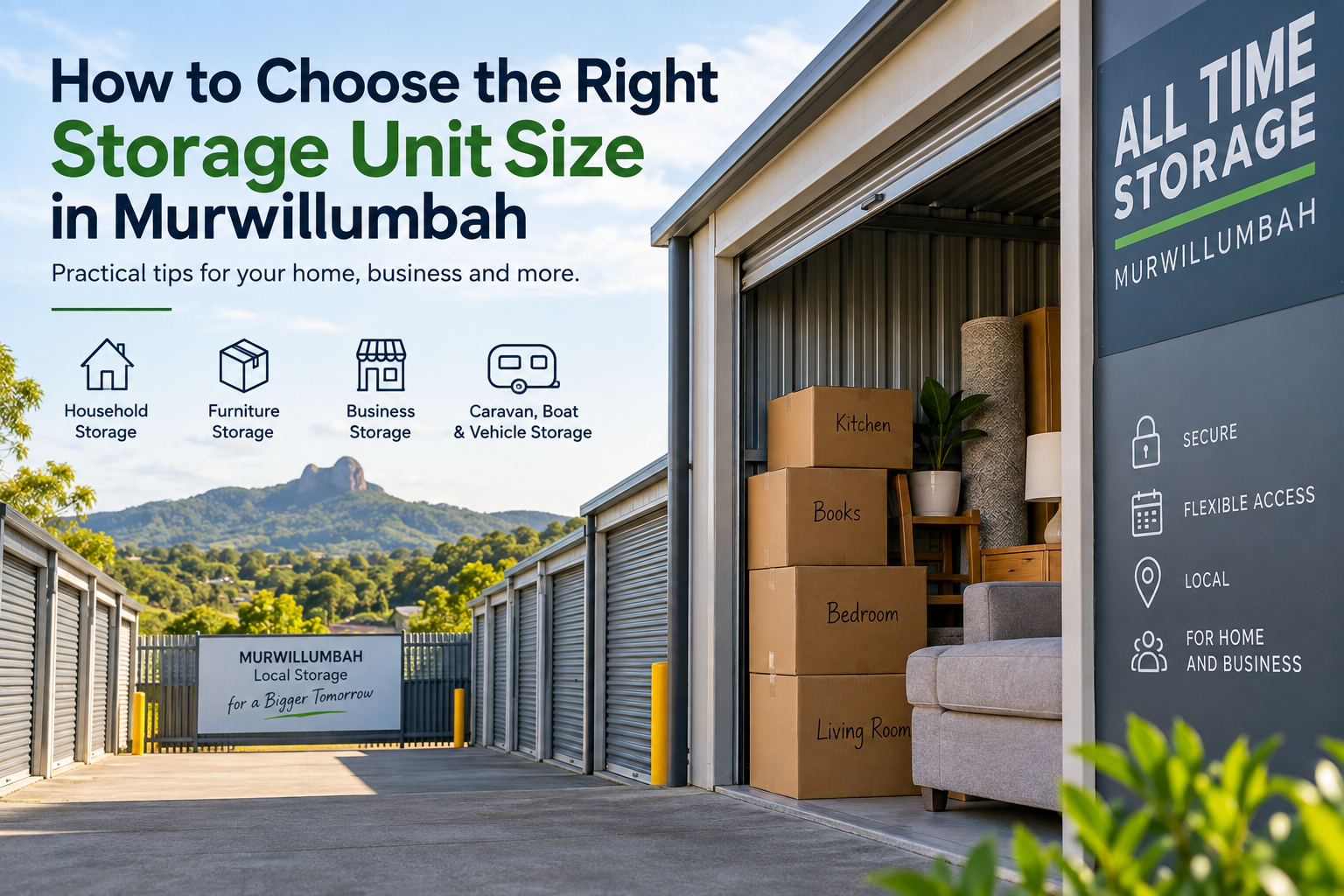
If you are searching for storage units in Murwillumbah, it is worth spending a little time working out your storage requirements before making a booking. Choosing a unit that is too small can make your belongings difficult to organise, while choosing a much larger space can mean paying for storage that you do not really need.
There is also more to choosing storage than simply making everything fit. You need to think about how long you will be storing your belongings, whether you will need regular access, how your furniture can be positioned and which items you are likely to need first.
At All Time Storage in Murwillumbah, customers use storage for many different reasons. Some are moving house, some are renovating or downsizing, while others need extra room for business stock, furniture or personal belongings. Because everyone’s situation is different, the right storage size will depend on what you need to store.
Here is a practical guide to help you make that decision.
Why Choosing the Right Storage Unit Size Matters
The size of your storage unit can affect your entire storage experience.
A unit that is too small may technically hold your belongings, but that does not necessarily mean it is the right choice. If boxes are stacked everywhere and furniture is pushed tightly against everything else, finding a particular item later can become difficult.
At the other end, choosing a much larger unit simply because you want extra space may increase your storage costs unnecessarily.
The ideal storage arrangement should give you enough room to:
- Store your belongings safely
- Organise boxes properly
- Position furniture sensibly
- Access important items when required
- Make practical use of the available space
Before choosing a unit, ask yourself three basic questions:
What am I storing?
How much space do my belongings actually take up?
How often will I need to access them?
Those answers will give you a much better starting point.
Start by Making a Complete List
The easiest way to estimate your storage requirements is to make a list of your belongings.
You do not need to measure every small item. Start with the larger things that will determine how the storage space is used.
For example, if you are moving house, your list might include:
Living Room
- Three-seater sofa
- Armchairs
- Television
- TV cabinet
- Coffee table
- Bookshelves
- Boxes
Bedrooms
- Bed frames
- Mattresses
- Wardrobes
- Bedside tables
- Drawers
- Clothing boxes
Kitchen
- Dining table
- Chairs
- Refrigerator
- Small appliances
- Kitchen boxes
Garage
- Tools
- Shelving
- Outdoor equipment
- Storage containers
Once everything is written down, it becomes much easier to discuss your requirements with a storage provider.
It also helps you avoid forgetting large items when estimating how much space you need.
Measure Your Larger Furniture
You don’t need to measure every chair or small table, but larger pieces of furniture are worth measuring.
Pay particular attention to:
- Sofas
- Wardrobes
- Beds
- Dining tables
- Cabinets
- Desks
- Shelving
- Refrigerators
- Washing machines
For example, a large corner sofa can take up considerably more room than a standard two-seater.
Similarly, a tall wardrobe may need to remain upright, which affects how you organise the storage space.
If you have unusually large furniture, mention it when discussing your requirements with the storage provider.
Count Your Boxes Before You Book
Boxes are another area where people often underestimate how much space they need.
You may start with the idea that you only have 15 or 20 boxes. Once you begin emptying cupboards, drawers, wardrobes and the garage, that number can increase significantly.
If you are preparing for a house move, go through each room and estimate the number of boxes.
For example:
- Kitchen – 10 boxes
- Main bedroom – 8 boxes
- Second bedroom – 6 boxes
- Living room – 8 boxes
- Office – 5 boxes
- Garage – 8 boxes
That is already 45 boxes.
Also remember that boxes come in different sizes. A box of books can be relatively compact but heavy, while a large box of bedding may take up more physical space but weigh much less.
This matters when planning how you will stack and organise your storage unit.
Think About What You Are Actually Storing
The amount of storage you need depends on the type of belongings you have.
Someone storing 40 boxes of clothing and books may require a very different storage arrangement from someone with 20 boxes plus a large sofa, two wardrobes and several appliances.
Large furniture generally determines the basic layout.
Boxes can then be positioned around the larger items.
This is why simply saying, “I have 30 boxes,” does not always provide enough information to estimate the right storage size.
Give the storage provider a rough idea of your biggest items as well.
Consider How Long You Will Need Storage
Your storage period can also influence the way you choose and organise your unit.
If you only need storage for a few weeks while moving between properties, you may have a fairly straightforward setup.
If you are planning long-term storage, your priorities can be different.
When belongings are going to remain stored for several months, organisation becomes much more important.
You may want to separate:
- Items you will need soon
- Seasonal belongings
- Furniture you will not use
- Family belongings
- Business stock
- Items that will remain untouched
Planning this before loading the unit can save you considerable effort later.
Storage During a House Move
Moving house is one of the most common reasons people need self storage in Murwillumbah.
There may be a gap between settlement and moving into your new home. Sometimes the new property is smaller, or perhaps you are preparing your existing property for sale.
In these situations, storage can give you somewhere to keep your belongings temporarily without filling every room in the house.
The amount of storage you need will depend on the size of your household.
A small apartment may only require a modest amount of space.
A four-bedroom family home with a full garage and outdoor furniture will obviously require considerably more.
Instead of guessing based on the number of bedrooms, make an actual inventory of your furniture and boxes.
Storage During a Renovation
Renovations can create a sudden need for additional space.
If builders need access to your rooms, leaving furniture where it normally sits may not be practical.
You may need to move:
- Sofas
- Beds
- Tables
- Cabinets
- Appliances
- Decorations
- Electronics
- Boxes
If you are renovating only one room, you may need less storage.
If the entire house is being renovated, your requirements could be much larger.
Think about the length of the renovation as well.
If the project is expected to take several months, organise the storage unit so you can access anything you may need during that period.
Storage When Downsizing
Downsizing is another situation where choosing the right storage unit size can be difficult.
Moving into a smaller home often means you have more belongings than your new property can accommodate.
But that does not mean you necessarily want to get rid of everything immediately.
Some furniture may have sentimental value. Family photographs, heirlooms and other personal belongings may not fit into your new home but may still be worth keeping.
Storage can give you time to make those decisions without rushing.
You can keep selected belongings in storage while you settle into your new home and decide what you genuinely need.
Think About Business Storage Too
Storage is not only useful for households.
Small businesses may also need additional space for:
- Product stock
- Packaging
- Equipment
- Tools
- Documents
- Displays
- Seasonal inventory
If you are looking for commercial storage in Murwillumbah, think carefully about how often you need access to your stock.
A business that needs to collect products every day will need a different storage layout from one that stores seasonal equipment.
For frequently accessed stock, keep popular items near the entrance.
For items that are only needed occasionally, the rear of the storage space may be more suitable.
Don’t Assume Bigger Is Always Better
It is understandable to think that choosing a larger unit will make everything easier.
More space can certainly provide flexibility, but there is a downside if you are paying for space you do not actually use.
Before choosing a larger unit, ask whether the extra room is genuinely useful.
Would you use it for additional belongings?
Would you need space for future items?
Will you need a walkway or access area?
If the answer is no, you may be better off choosing a more appropriately sized unit.
The aim is to find a practical balance.
Don’t Choose Based Only on Price
When comparing storage in Murwillumbah, price is naturally one of the things you will consider.
But it should not be the only factor.
Think about the overall value of the storage arrangement.
Consider:
- Size
- Location
- Access
- Security
- Convenience
- Storage period
- Your expected frequency of visits
A slightly different storage option may work better for you even if the initial price is not the lowest.
If you are going to visit regularly, convenience can be particularly important.
Consider How Often You Will Access Your Storage
This is one of the questions people often forget to ask themselves.
Will you need to visit once every few months?
Or will you need to visit several times a week?
Your answer can change the way you organise your belongings.
For occasional access, you can place long-term items towards the back.
For frequent access, keep commonly needed belongings closer to the entrance.
For example, if you are storing business stock, your most popular products should be easy to reach.
If you are storing furniture during a house renovation, you may want to keep tools or household essentials accessible.
Use Vertical Space Carefully
When planning your storage layout, don’t think only about the floor.
Depending on the storage space and the items involved, you may be able to use vertical space by stacking suitable boxes.
However, safety should always come first.
Heavy boxes should not be placed on top of delicate items.
Fragile belongings should be protected.
Boxes should be stable rather than stacked simply to reach the ceiling.
Using the available height intelligently can help you make better use of your storage area without automatically choosing a much larger unit.
Dismantle Furniture Where Practical
Some furniture can be dismantled before storage.
This can make transportation easier and may help you use the available storage space more efficiently.
Suitable examples may include:
- Bed frames
- Dining tables
- Desks
- Shelving
- Some cabinets
Keep screws, bolts and fittings together.
A small labelled bag such as:
“Queen bed fittings”
can save a lot of frustration later.
You may also want to take a photograph of the furniture before dismantling it, particularly if it has several components.
Plan Where Your Furniture Will Go
Before moving everything into your unit, think about the layout.
You don’t want to arrive with a truck full of furniture and then decide where everything goes as you unload.
Instead, create a basic plan.
For example:
Front: boxes and belongings you may need
Left side: bedroom furniture
Right side: living room furniture
Back: long-term storage items
This does not need to be perfect.
The purpose is simply to give you a logical system.
Leave Practical Access
One of the biggest storage mistakes is filling every available space.
Everything may fit, but you might not be able to reach anything.
If you need something at the back, you could end up moving half the unit just to get to it.
If you know you will need regular access, leave enough practical room to reach the important areas.
You do not necessarily need a large walkway through the entire unit.
You simply need a layout that reflects how you expect to use your storage.
Label Your Boxes Clearly
Good labelling makes a storage unit much easier to manage.
Avoid labels such as:
Household
or:
Miscellaneous
Instead, be specific.
For example:
Kitchen – cookware
Bedroom – winter clothing
Office – documents
Garage – hand tools
If you have a large number of boxes, number them as well.
For example:
Box 01 – Kitchen
Box 02 – Kitchen
Box 03 – Bedroom
Then keep a simple list on your phone.
Create an Inventory
An inventory is especially useful if you are using storage for a long period.
It can be as simple as a spreadsheet.
| Box Number | Contents | Position |
|---|---|---|
| 01 | Kitchen items | Front left |
| 02 | Bedding | Front right |
| 03 | Books | Rear left |
| 04 | Office items | Rear right |
For valuable belongings, take photographs before storage.
This gives you a record of what you have stored and can also help you remember where specific items are.
Use a Storage Space Calculator
If you are not sure how much space you need, a storage space calculator can be a useful starting point.
All Time Storage provides a space calculator that can help customers estimate their storage requirements.
Start by making your furniture and box list first.
Then use the calculator to get an approximate idea of the space you may require.
Remember that an online calculator is only an estimate. The actual space required can depend on how your belongings are packed and organised.
If you are still uncertain, discuss your requirements with the storage provider before booking.
Think About Security
The size of a storage unit is important, but so is the facility where your belongings are kept.
If you are comparing secure storage in Murwillumbah, ask what security measures are provided.
At All Time Storage, security includes:
- 24/7 CCTV
- Individualised gate PINs
- Individualised padlocks
These are useful things to consider when deciding where to store household belongings, furniture or business stock.
Security should be considered alongside storage size rather than as an afterthought.
Consider Access Hours
Access arrangements can make a significant difference, particularly if you work during normal business hours.
At All Time Storage, customers generally have access seven days a week from 6am to 7pm, with after-hours access available by arrangement.
If you are moving house or running a business, flexible access can be useful.
Before choosing a storage facility, check the current access arrangements and make sure they fit your schedule.
Location Can Make Storage Easier
If you live in Murwillumbah, having a local storage facility can make regular visits more convenient.
This is especially useful when storage is part of an ongoing house move, renovation or business operation.
Customers from nearby areas such as Tweed Heads, Chinderah, Kingscliff, Coolangatta and Byron Bay may also consider Murwillumbah storage depending on their location and how often they need access.
Think about your normal travel routes.
If you are visiting your storage unit once every six months, distance may not matter much.
If you need to visit every week, a convenient location can save considerable time.
What If You Are Still Unsure?
If you have made your list and you still cannot decide between two storage sizes, don’t simply guess.
Speak with the storage provider.
Give them information about:
- Your largest furniture
- Number of boxes
- Appliances
- Business stock, if applicable
- Storage duration
- Expected access frequency
The more information you provide, the easier it is to discuss your requirements.
It is much better to ask questions before booking than to discover after moving everything that the space does not work for you.
A Simple Storage Planning Checklist
Before choosing your storage unit, go through this list.
Furniture
☐ Sofa
☐ Beds
☐ Mattresses
☐ Wardrobes
☐ Cabinets
☐ Dining table
☐ Chairs
☐ Desks
Appliances
☐ Refrigerator
☐ Washing machine
☐ Dryer
☐ Other large appliances
Boxes
☐ Kitchen
☐ Bedrooms
☐ Living room
☐ Office
☐ Garage
☐ Personal belongings
Other Items
☐ Tools
☐ Outdoor furniture
☐ Business stock
☐ Equipment
☐ Seasonal belongings
Access
☐ How often will I need access?
☐ Which belongings will I need first?
☐ Have I planned the layout?
☐ Have I labelled the boxes?
☐ Have I created an inventory?
Common Mistakes to Avoid
Choosing a Unit That Is Too Small
Trying to save money by choosing a very small unit can make your belongings difficult to access.
Choosing a Unit That Is Much Too Large
Extra space is useful only if you actually need it.
Forgetting Large Furniture
Don’t estimate your requirements based only on the number of boxes.
Ignoring Access
If you need regular access, make sure your storage layout allows it.
Packing Without a Plan
Loading everything randomly can make your storage unit difficult to manage.
Not Labelling Boxes
You may remember everything today, but that can change after several months.
Ignoring Vertical Space
Where appropriate and safe, use the available height rather than thinking only about floor area.
Choosing Storage Units in Murwillumbah
If you are searching for storage units in Murwillumbah, start with your belongings rather than a particular unit size.
Make a list.
Measure your larger furniture.
Count your boxes.
Think about how often you will need access.
Then consider the storage facility itself.
Look at its location, access arrangements, security and suitability for your requirements.
All Time Storage is located at 57 Quarry Road, Murwillumbah, NSW 2484 and provides storage options for household and business requirements, along with caravan, boat and motor vehicle storage.
If you are unsure about the amount of space you need, preparing a list of your belongings and discussing it with the storage team can help you make a more informed decision.
Frequently Asked Questions
How do I know what size storage unit I need?
Start by listing your large furniture, appliances and boxes. Measure larger items where possible and think about how frequently you will need access. You can also use a storage space calculator as a starting point.
Is a bigger storage unit always better?
No. A larger unit may give you additional flexibility, but if you do not need the extra space, you could be paying for unused capacity. Choose a size that suits your actual belongings and storage plans.
How much storage do I need when moving house?
It depends on the size of your home and the amount of furniture and belongings you have. A small apartment will generally require less storage than a large family home with several bedrooms, garage equipment and outdoor furniture.
Can I store furniture in a storage unit?
Suitable furniture can generally be stored, subject to the storage provider’s requirements. Clean and dry furniture before storage and use suitable protective materials.
Should I dismantle furniture before storing it?
If the furniture can be safely dismantled, doing so can make it easier to transport and organise inside the storage space. Keep all fittings together and label them clearly.
How can I make better use of my storage space?
Plan your layout before loading, use strong boxes, dismantle suitable furniture and stack appropriate items safely. Keep frequently needed belongings near the entrance and label everything clearly.
Can businesses use storage units?
Yes. Businesses may use suitable storage for stock, equipment, documents, packaging and other belongings. The appropriate size depends on the quantity of items and how often you need access.
Should I leave space to walk inside the unit?
If you expect to access your belongings regularly, practical access space can be very useful. Your layout should reflect how often you expect to visit.
What should I consider besides storage size?
Look at location, access hours, security, convenience and your expected storage period. These factors can be just as important as the physical size of the unit.
Final Thoughts
Choosing the right storage unit size in Murwillumbah starts with understanding what you actually need to store.
Make a list of your furniture, appliances and boxes. Measure the larger items and think about how often you will need access. From there, you can get a much clearer idea of the amount of storage space that makes sense for you.
Don’t focus only on fitting everything inside the unit. Think about what happens after it is loaded.
Can you find your boxes?
Can you reach the belongings you may need?
Can the furniture be positioned sensibly?
Have you labelled everything?
These details may seem small when you are preparing for a move, but they become much more important after your belongings have been sitting in storage for several months.
For people moving house, renovating, downsizing or looking for additional household storage in Murwillumbah, good planning can make the process much easier.
For businesses, the same principle applies. Work out what needs to be stored, how often you need access and how your stock or equipment should be organised.
If you are considering self storage in Murwillumbah, All Time Storage can help you explore suitable storage options based on your requirements. The facility also provides caravan, boat and motor vehicle storage for customers with larger storage needs.
The right storage unit is not necessarily the largest one available. It is the one that gives you enough practical space for your belongings, suits the way you use storage and makes sense for your budget.
Take a little time to plan before moving everything in. It can save you a lot of time, effort and unnecessary rearranging later.